
Market Structure
Polymarket Is Building an IPO, Not an Airdrop
August 16, 2026 · live Polymarket data on the leaderboard
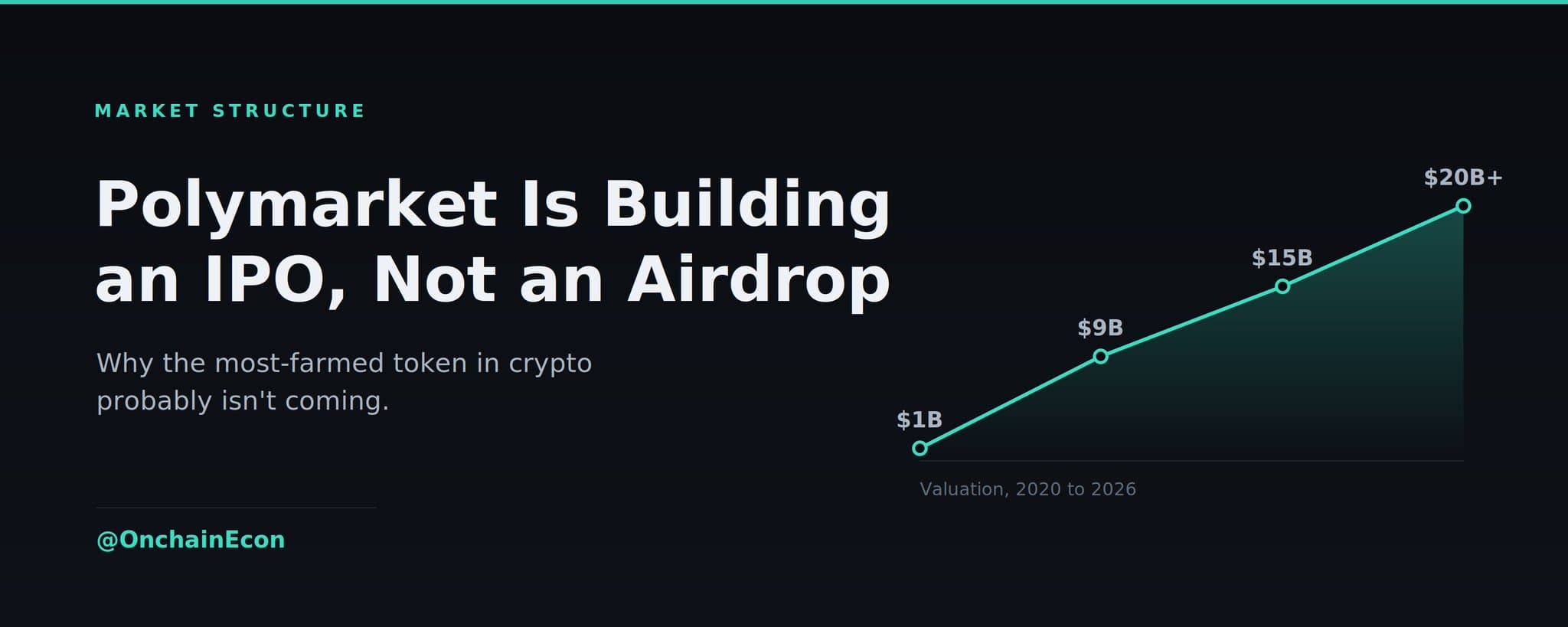
The most-farmed token in crypto probably isn't coming, and the reason exposes a contradiction at the heart of the entire crypto-to-TradFi thesis.
For two years, a certain kind of crypto user has treated a Polymarket airdrop as a matter of when, not if. The company's CMO said it out loud, on a podcast: "there will be a token, there will be an airdrop." People linked their X accounts, spread their volume across markets, and waited.
The problem is that everything Polymarket has actually done over the past year points somewhere else entirely: toward a Wall Street IPO. And an airdrop and an IPO are not two steps on the same path. They pull in opposite directions.
None of what follows relies on inside information. It is an argument built from public reporting, from on-chain data, and from the structure both reveal. But the structure is loud.
The glide path
Start with the money. In early August, Reuters, Bloomberg and CNBC all reported that Polymarket is in talks to raise roughly $1 billion at a valuation north of $20 billion. That would more than double the roughly $9 billion it was worth last October, when Intercontinental Exchange, the parent company of the New York Stock Exchange, agreed to invest up to $2 billion and became its largest strategic shareholder. In between, per Bloomberg, an April round valued the company around $15 billion and brought in D.E. Shaw. The company has told CNBC its annualized revenue is well above $1 billion.
The valuation curve tells the story on its own:
Polymarket funding rounds
| Date | Round | Valuation |
|---|---|---|
| Oct 2020 | Seed | not disclosed |
| May 2024 | Series B | ~$1B |
| Oct 2025 | Strategic (ICE) | ~$9B |
| Apr 2026 | Growth | ~$15B |
| Aug 2026 | In talks | $20B+ |
Sources: FT, Reuters, Bloomberg, CNBC, The Block. Valuations approximate.
Then look at who is circling. According to the Financial Times and The Block, JPMorgan cut Polymarket's banking relationship in October 2025 over regulatory concerns, and is nonetheless positioning to underwrite a potential IPO, reportedly inviting CEO Shayne Coplan to a private-banking event for wealthy clients in Miami. When the NYSE's parent is your biggest backer, D.E. Shaw and Point72 are on your cap table, and JPMorgan wants the underwriting mandate, you are not building a crypto protocol anymore. You are building a listable company.
And it is a company with real usage, not a farm. On-chain data from Strata puts Polymarket's all-time volume above $43 billion across more than three million wallets. This is a business that no longer depends on airdrop hunters to generate activity, which is precisely what makes the next question interesting.
Polymarket on-chain, measured by Strata
Measured on-chain from Polygon: reward senders' USDC transfers and fee events decoded from Polymarket's exchange contracts. Figures as of publication (Aug 16, 2026) — live versions on the stats dashboard.
Why a token becomes a liability
Here is where the airdrop thesis breaks. For a company on this path, a retroactive retail token is not an asset. It is a stack of risks.
Polymarket is already under regulatory scrutiny: a 2022 CFTC settlement, an FBI raid in late 2024 that was dropped without charges in 2025, and, per recent reporting, a fresh CFTC inquiry, a Baltimore lawsuit, and a New York City Council probe into prediction-market marketing. Launching a token into that is close to the worst possible timing. A token distributed broadly to anonymous wallets is, to a US regulator, an unregistered securities offering in a crypto costume. It invites dilution. It complicates the cap table. And it plants a red flag directly in front of the underwriters the company is trying to court.
There is also a quieter dynamic on the cap table itself. Polymarket's early backers are crypto-native: Blockchain Capital, Polychain, Dragonfly, 1confirmation, Coinbase. For those funds, a token is the classic liquidity event, the crypto way to realize a return without waiting for an IPO. But the gravity has shifted. ICE, D.E. Shaw, Point72, and a JPMorgan-underwritten listing represent the traditional path, and that path is now clearly winning. The token faction and the IPO faction want incompatible exits, and the IPO faction is holding the pen.
But surely they'll reward users somehow
This is where most takes stop, with a comforting fallback: even without a token, Polymarket will reward its community some other way. That deserves to be taken seriously, because it is where the real insight is, and it does not survive contact with the details.
Consider the three obvious non-token rewards.
First, the liquidity rewards Polymarket already runs. These are real, and large: Strata data shows roughly $96 million distributed all-time. But they are not a community reward. They are maker rebates. The platform pays users who post limit orders and provide depth, returning part of the fees that liquidity itself generates. The economics are explicit on-chain. Since late April, Polymarket has collected about $141 million in taker fees and paid roughly $65 million of it back as rewards, keeping the rest as protocol earnings at a 53.7% margin. Read that again: the rewards program is a fee rebate with a healthy margin on top. The house takes its cut and returns part of the vig to the market makers who keep the book liquid. That is not a community gift waiting to be crowned with a token. It is the cost of running an order book, and the company keeps the majority.
Second, IPO access, letting top users buy shares at the offer price, the way Robinhood did with its own listing. Structurally elegant: it converts "we owe our early users something" into "here is a way to own the equity." Except Polymarket's core user base is overwhelmingly international. US users were locked out entirely until months ago. Handing IPO allocations to Americans while excluding the international users who actually built the volume would be both absurd and backwards, and US IPO allocations are, in practice, restricted to US residents anyway. The cleanest equity-style reward reaches exactly the wrong users.
Third, "the best reward is a great product." This is what a company says when it intends to pay nothing. It is a non-reward wearing a bow.
Strip those away and something uncomfortable is left standing.
The user who can't be paid
The people who most deserve a retroactive reward, the international users who generated the volume, are the only group that cannot be reached by any clean, legal, TradFi-compatible mechanism. Liquidity rebates pay market makers, not them. IPO access is for the small, new US base. A good product is not a reward. Every tool a listing-bound company can safely use points at the US side or at operational cost. None of them distributes value back to the international core.
Which means, for that core, the honest answer is stark: it is an international token, or it is nothing. There is no elegant third door. And because the company has every reason to avoid the token (the IPO, the CFTC, ICE, dilution), the most probable outcome is that the users who farmed hardest receive no retroactive compensation at all. Not out of malice, but because the only instrument that would reach them is the one their situation pushes them not to use.
The single crack in that conclusion is, again, the cap table. Precisely because the international market is where a token is legal and where it is the only distribution tool that works, the crypto-native investors can make an internal case: issue a token on the international entity alone, geoblock the US, leave the listable business untouched. That is the one scenario in which an international user gets paid, and notice it would not happen out of generosity. It would happen because crypto VCs want their liquidity, and an isolated international token is the only way to give it to them without contaminating the IPO.
The contradiction this exposes
Zoom out, because this is not really about Polymarket.
The pattern is the signature of crypto growing up. The moment a crypto business becomes valuable enough to attract serious institutional capital is the moment its cleanest value capture migrates to equity, to ICE, to the listing, to the shareholders, and away from any token. The crypto-native user, the one the industry promised early and permissionless access to network upside, is left holding the one instrument regulation now makes hardest to deliver. The value is real and growing. It simply accrues to the cap table, not the community.
Polymarket is the clearest case. It sits exactly on the fault line: a US-regulated, CFTC-blessed, IPO-bound entity on one side, and a permissionless international protocol on the other. Equity-style rewards live on the regulated side. Token-style rewards live on the permissionless side. And the two do not meet, which is why the users on the international side, the ones who built the thing, may end up watching the value they created get underwritten by a Wall Street bank they will never buy a single share from.
The airdrop everyone is farming is not late. It is structurally in tension with the company Polymarket has decided to become. If it ever arrives, it will not be the generous retroactive drop the farmers are pricing in. It will be a narrow, geo-fenced instrument issued because someone on the cap table needed liquidity. And if it never arrives, that will not be a delay either. It will be a choice.
Published on X first. Follow @OnchainEcon for the next piece.